Madrid
6:51 pm, Aug 27, 2026
 21°C
21°C overcast clouds
21°C The square was originally planned by Felipe II and his architect Juan de Herrera, but was inaugurated in 1620 during Felipe III’s reign, whose statue sits proud in the very centre of the square. Juan Gómez de Mora gave it its rectangular form, and after it had suffered three fires Juan de Villanova completed the work in 1853 by joining the four sides.
Over the years, the square has had many different names. Located at the confluence of the paths towards Toledo and Atocha, it was originally the site of the “Plaza del Arrabal” market and thus took this name before later becoming the Plaza Mayor.
Since then it has also been called the Plaza de la Constitución, Plaza Real and Plaza de la República before returning to the now famous Plaza Mayor name at the end of the Spanish Civil War. Public executions, crowning ceremonies, bullfights, Inquisition trials and diverse fiestas have all taken place right here in the square.
The square is mostly surrounded by three-storey houses with balconies looking out onto the square and still lived in by the fortunate few.

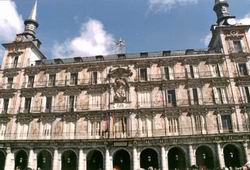
Located at the north end of the square resides the four-storey Casa de la Panadería building, supposedly named after the bakery it replaced.
The construction of this building and its colourful façade of frescos was initiated in 1590 and it has been renovated several times over the years, most recently when the frescos were repainted with designs by Carlos Franco, in 1992.
Top Plaza Mayor photo courtesy of guidacla on Flickr
Error: File not found or invalid path. Error: File not found or invalid path. Error: File not found or invalid path.